
Die reis van die HMS Guardian is ‘n unieke verhaal in seevaart geskiedenis.
 Die Guardian keer terug na Tafelbaai, 22 Feb 1790 (waterverf skets deur Lt Edward Riou)
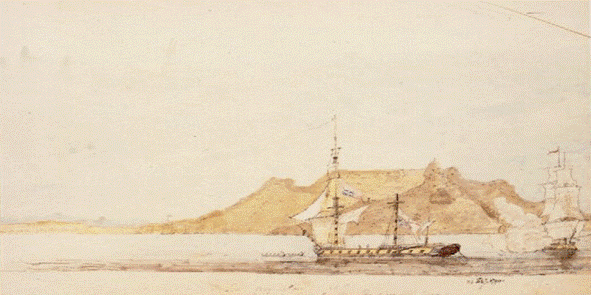 Die Guardian keer terug na Tafelbaai, 22 Feb 1790 (waterverf skets deur Lt Edward Riou)
Die HMS Guardian verlaat Spithead in September 1789, gelaai met proviand vir Brittanje se nuwe kolonie in Nieu-Suid-Wallis. Sy haal egter nie haar bestemming nie. Dertien dae buite die Kaap van Goeie Hoop tref sy ‘n ysberg wat haar roer en ‘n groot deel van haar kiel wegskeur. Die helfte van die bemanning vlug in reddingsbote, maar slegs een van hulle oorleef die 1300-myl vaart terug na die Kaap.
 Bemanningslede van die HMS Guardian poog om die sinkende skip te ontsnap.
Teen alle verwagtinge vaar die beskadigde Guardian ‘n maand later Tafelbaai binne. Haar jong kaptein, Edward Riou, spandeer ‘n jaar in die Kaap, waar hy in spanning wag vir sy opdragte. Uiteindelik beveel die Admiraliteit dat die skip vernietig moet word, en Riou moet terugkeer huis toe.
 Edward Riou
 Edward Riou
Hierdie publikasie bevat die volle verhaal van die Guardian se vaart soos neergeskryf in die skip se logboeke en briewe. Die dokumente beklemtoon die noue verhoudings wat heers in die Koninklike Vloot. Die oponthoud en gepaardgaande probleme wat veroorsaak is deur die ‘tyranny of distance’ van twee eeue gelede is iets wat die moderne lesers hulself met moeite sal kan indink. Captain Cook en die natuurkundige Sir Joseph Banks, die ontwerper van die Guardian se agterdek wat gevul was met plante vanuit die Kaap van Goeie Hoop, asook die Bounty muitery vorm deel van die Guardian se verhaal.
 Geskatte roetes van die Guardian en die reddingsboot.
UITTREKSEL VANUIT DIE TEKS
“….. and delay, with the water gaining very fast upon the pumps then employed: all the hands that could be spared were set to work to clear the deck of the cattle, booms of the hay and gun carriages, bows of the spare anchors, and between decks aft, of the provisions and such articles as could be got up, and hove overboard, holding themselves in readiness to man the pumps as soon as repaired and put in proper [order]. They were employed accordingly, and withdrawn as required.
By about 9 o’clock, the pumps were all at work, and three or four people were left between decks, to hoist up, and heave overboard what they could manage. The water had at this time encreased to three feet and an half, and was still gaining on all the pumps. Our spirits, however, were good, and the work applied to in great earnest, both at the pumps, in the hold, and throughout the ship in general. The few hands left between decks did almost more than their strength could be expected to effect: in the course of an hour, they got up and hove overboard most of the bags of flour, pease, wheat, barley, &c. received at the Cape of Good Hope, besides several small casks for the Colony, also two hogsheads of tobacco. These were broken in pieces, and the tobacco torn asunder in fleaks, which were on deck, and flung overboard. At about half past 9 o’clock, one of 4 chain pumps breaking, Mr. Sommerville, the Gunner, and a few more went down between decks, and thus reinforced, the men below got a number of casks of different kinds, also a considerable quantity of bread, and boxes and packages out of the gun-room, which were all committed to the sea. At about 10 o’clock, we were obliged to break off from clearing away below, to shut and cover over the hatchways with tarpaulings, to prevent the roll of water going down between decks, which the scupper did not vent near so fast as the pumps threw up. By this time the Water had encreased to above feet, the larboard pumps only at work. The carpenters were still employed repairing the chains of the starboard one, and a few people engaged about one of the guns, abreast of the mainmast on the same side. The hands coming up from below, were sent to assist them to launch it overboard, and by the time they had effected the business, the pumps were repaired, and in readiness for them to go to work on.
Since the first of our misfortunes, there had not yet been an officer or man, but was laboriously employed in one way or other, and there still remained business for treble the number of hands; it was, however, impossible that the few we had could [hold] out much longer if continued to be employed together; a reservation was accordingly made, by dividing the whole of the officers, seamen, convicts, &c. into two watches to relieve alternately by the half hour, and at about half past ten, the first division on spell went on to the pumps. At this time, the Captain ordered refreshments to be allotted to each man, taking particular care that the grog should not be made too strong. Every man received a dram for the first supply, with biscuit and cheese, which seemed to give them fresh spirits to return to their laborious duty. The rum above was soon nearly expended, but the Captain thought it would be extremely dangerous to open the Hold to get more, for fear of the men’s getting at it. Wine and Water was accordingly given in lieu of it, as a small cask had been got up on the first clearing away be gun room and between decks.
At midnight, the water had increased to six feet, and it was then blowing a very strong gale of wind, and an immense high sea running. The ship at his time steered N.N.W. to N.W. by W., the wind at N.E. to N.N.E. At day break a few hands were set about filling one of the lower studding sails with oakum, by sewing it up to the sail in rolls. At five A.M. the water was u-half feet in the hold, and the off watch were ordered to get the sail under be ship’s bottom, which was found to be extremely difficult. The leak however gained upon us near a foot water during this application. By unwearied labour at the pumps, however, it became reduced, and continued diminishing till near eleven o’clock, when the water was reduced to on1y nineteen inches.
At half past eleven o’clock we were, however, unhappily informed that the leak had again gained on us some inches, and continued so to do, more or less, for a short time. Another sail was nextly prepared for a second fothering, which again encouraged our hopes. At noon the water was at 27 inches, the ship’s head about W. the wind blowing very hard.
December 25
It still continued to blow a strong gale of wind with very cloudy weather, and frequent showers of hail and rain, the sea running extremely high, often breaking over the ship with great violence. Between one and three o’clock P.M. the second fothering was got under the ship’s bottom. About this time [some] of the crew became almost unable to perform any duty, from their limbs being benumbed by the frequent transition from the heat of labour, and having rested in wet cloaths. The weather was likewise uncommonly piercing. At four P.M. the water again gained on us, when Mr. Clements went down by the way of the rudder into the gun room, from thence into the bread and spirit rooms to endeavour to discover the leak, but without effect. It was then thought fit to endeavour to scuttle the deck close aft, which being out of the roll of the water, would enable us to get up and heave overboard some more of the cargo.
Accordingly the Captain, the Chaplain, the Purser, and two men were employed in this business, but unfortunately endeavouring to heave up a cask, it fell back on the Captain, and bruised his hand in so shocking a manner, as to disable him from giving any further assistance.”
Edited with an introduction by M D Nash
M.D. Nash was voorheen die hoof van die kulturele afdeling van die Port Elizabeth en Albany Museums en is ‘n vooraanstaande kenner van die geskiedenis van die 1820 setlaars. Haar belangstelling in maritieme geskiedenis het ontstaan ná navorsing oor skeepswrakke en die gepaardgaande reddingspogings aan die kus van Port Elizabeth.